

INTERPOL launches Red/Blue Team drone exercise to strengthen protection of critical infrastructure
An international security simulation in Malmö will test how authorities respond when drones become a threatIn April, law enforcement specialists, security experts, and drone professionals from several countries will gather in Malmö, Sweden, for an exercise that reflects a rapidly changing security landscape.
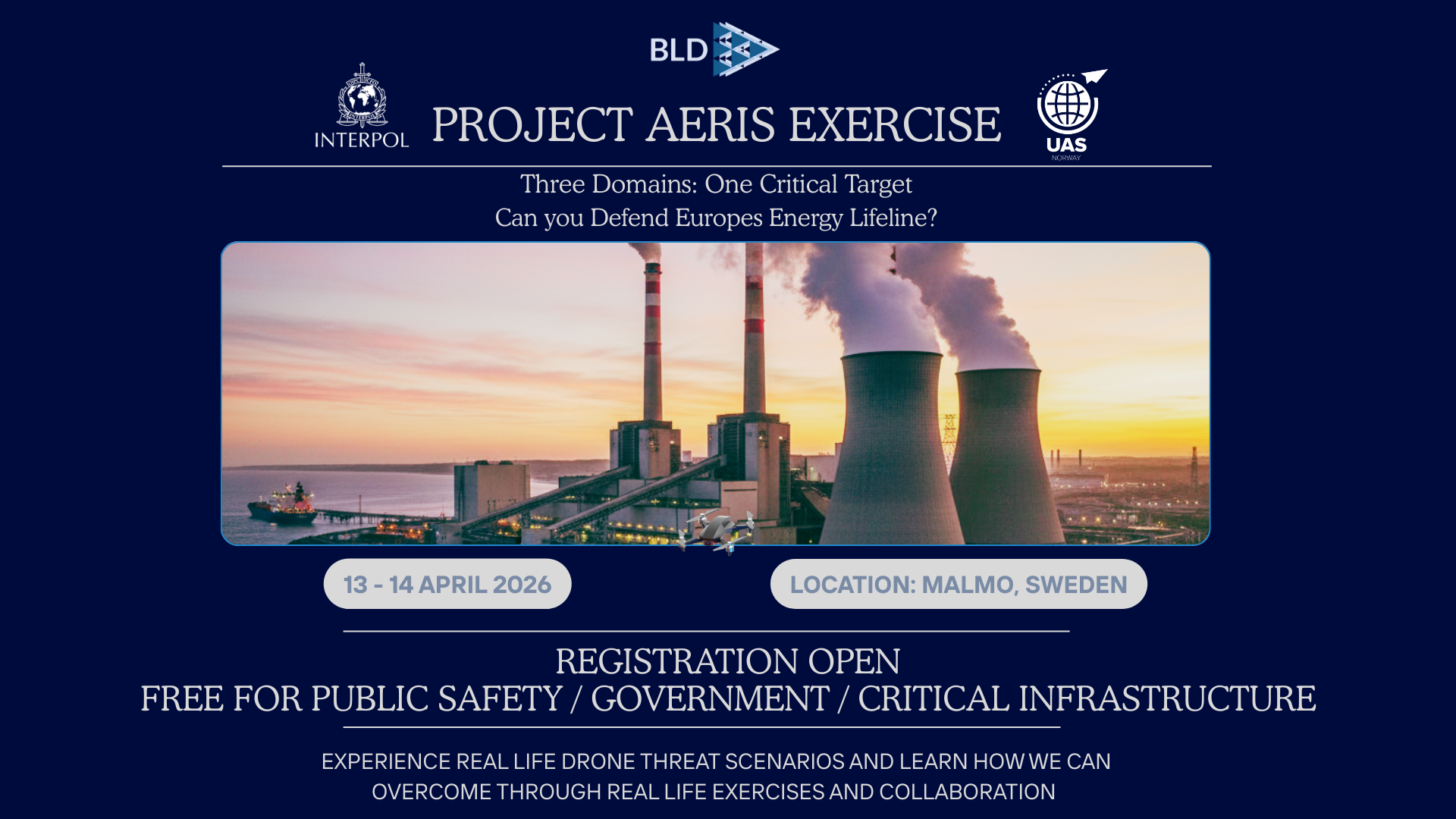
On 13–14 April 2026, INTERPOL and UAS Norway will host its first Unmanned Systems Table Top Exercise focused on drone incursions targeting critical infrastructure. The event will bring together agencies and experts to simulate incidents involving unauthorized or hostile drones and to examine how authorities respond when the airspace above sensitive sites is compromised.
While the exercise will take place around a conference table, the issues being discussed are far from theoretical.
To read more about the event and sign up, enter the event webpage here
Across Europe and beyond, drones are increasingly appearing near airports, energy facilities, ports, and other critical infrastructure. These incidents highlight the growing challenge of detecting, tracking, and responding to unmanned aircraft that may pose safety or security risks.
From technological capability to operational reality
The Malmö exercise is designed to bridge a gap that many authorities are now confronting. Technological solutions for detecting and countering drones are advancing quickly, but operational coordination and legal frameworks often struggle to keep pace.
Participants in the exercise will explore how agencies share information, coordinate responses, and make critical decisions when confronted with a drone intrusion. By using realistic scenarios based on previous incidents, the exercise aims to test both procedures and assumptions in a controlled environment.
Unlike large field exercises involving equipment and vehicles, a Table Top Exercise focuses primarily on decision-making and coordination. Participants discuss their roles, responsibilities, and potential actions during simulated incidents, allowing them to identify weaknesses in procedures and communication before a real crisis occurs.
Red Team versus Blue Team
A central element of the exercise is the Red Team and Blue Team structure.
The Red Team represents the adversary and develops potential drone intrusion scenarios. The Blue Team represents the authorities responsible for detecting, assessing, and responding to those threats.
This structure allows participants to explore how adversaries might exploit vulnerabilities while simultaneously testing how well authorities can respond under pressure.
By examining both sides of the problem, the exercise creates a more realistic understanding of how drone incidents might unfold and how responses can be improved.
Addressing the legal and operational challenges
Counter-drone operations often involve more than technology. They require a clear understanding of legal authority, operational responsibilities, and coordination across multiple agencies.
In many countries, responsibilities for responding to drone incidents are divided between law enforcement, aviation authorities, military organizations, and infrastructure operators. This complexity can create uncertainty during a crisis if roles and procedures are not clearly defined.
The Malmö exercise will therefore focus not only on operational response but also on the legal and regulatory frameworks that govern the use of counter-drone technologies.
Participants will examine how these frameworks influence decision-making and how agencies can better coordinate their actions within existing legal structures.
Preparing for the next phase
The exercise in Malmö represents an important step in a broader initiative focused on unmanned threats.
Insights gathered during the discussions will help inform the planning of IXES2026 – the INTERPOL Unmanned Expert Summit, where participants will move from simulation to live operational testing in June 2026.
Where the Malmö event focuses on strategy, coordination, and decision-making, the larger summit will examine how technologies and operational concepts perform in real-world scenarios.
Taken together, these events represent a growing international effort to prepare authorities for a future in which unmanned systems will play an increasingly prominent role in both society and security.
This article was written using AI and subsequently reviewed and quality-assured by UAS Norway’s content producer.
